How Manufacturing Plant Profiles Differ from Company Profiles
Sales teams missing plant-level detail lose deals in the first ninety seconds.
The distinction between a company profile and a plant profile comes down to what each was built to answer. A company profile tells you who a manufacturer is on paper, while a plant profile tells you what a specific facility runs, makes, and needs this quarter. Confuse the two and you get what most industrial sales floors actually run on: reps guessing at a process type instead of knowing it, and paying for that guess in the first ninety seconds of a call.
The structural shape of U.S. manufacturing and why it makes the distinction urgent
Roughly 290,000 manufacturing establishments in the U.S. generate around $6 trillion in combined annual sales, per First Research's October 2025 figures. The bigger number matters less than how that base splits. About 71% of manufacturers run out of a single location, while the other 29% belong to a multi-location operation, according to IndustrySelect's database, and that gap changes what a sale looks like before anyone dials a number.
Walk into a single-location shop and the owner is probably on the floor right now, not behind a desk. Buying authority sits with one or two people, no corporate layer, no routing required. A multi-location company works differently: purchasing might live at headquarters, or it might live at each plant, and nothing in a company profile tells you which. Layer on the fact that most of this market is privately held, so financial statements are scarce, and sales teams end up filling the gaps with firmographic guesswork.
A company profile confirms a manufacturer exists, but it has no way to tell you where the purchasing decision actually sits, or what that plant needs on a given Tuesday. It was built for a different job entirely.
What a company profile contains and where it runs out of road
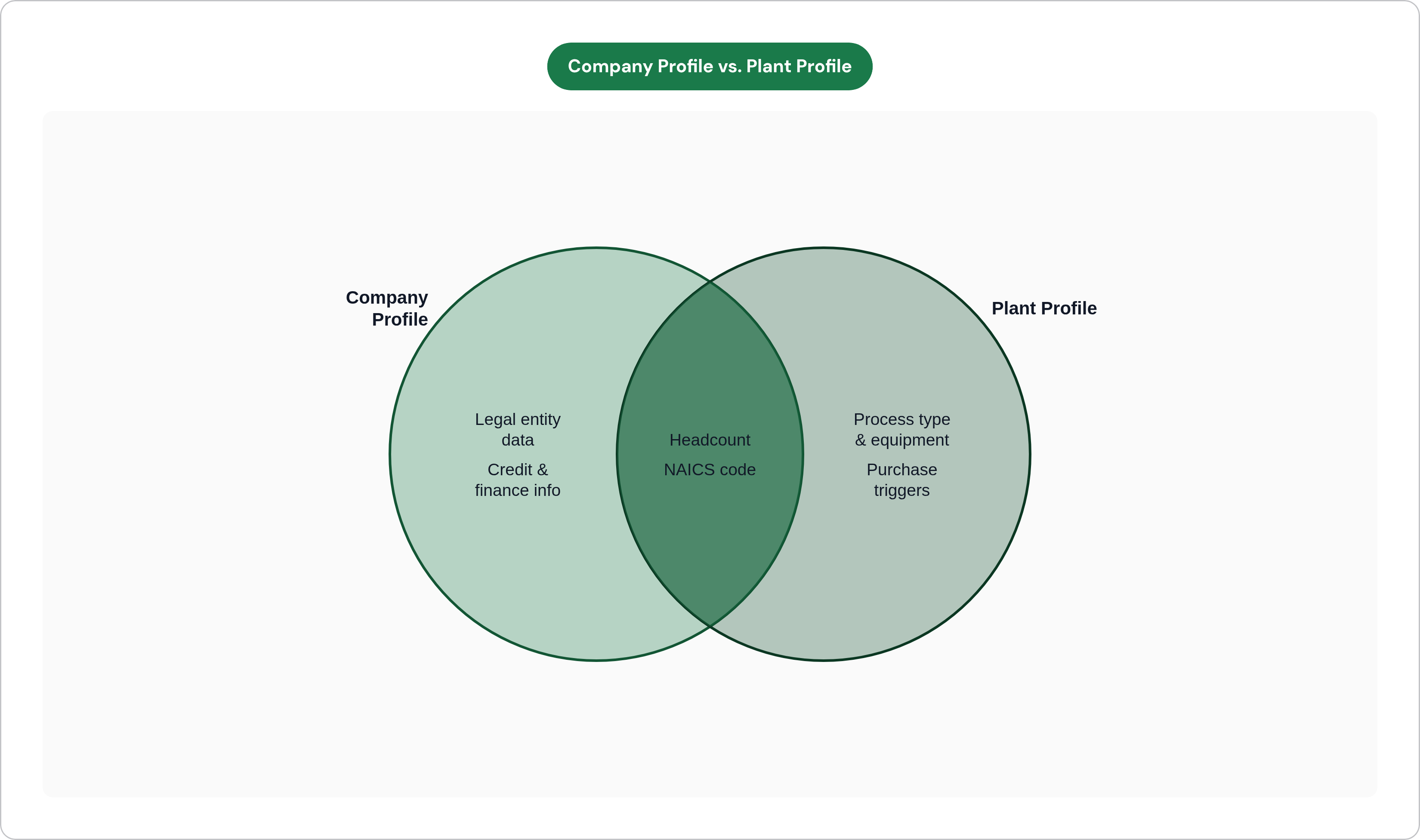
Company profiles earn their keep somewhere else. They map parent-subsidiary relationships, support credit checks, identify the legal entity that signs the purchase order, and flag the leadership change or acquisition that made the trade press. Legal, finance, and credit teams need exactly that layer of information, and a company profile delivers it well.
The trouble starts when a sales team asks that same document a question it was never designed to answer. A corporate NAICS code reflects the parent's primary revenue classification, which tells you nothing about what any individual plant inside that company actually produces. Consolidated headcount and revenue are aggregates; a 40-person plant belonging to a large conglomerate looks, on paper, identical to a standalone 40-person shop. There's no field for process type, no field for installed equipment, no field for what certifications a given address holds or how much it ships out in a shift.
Take two plants sitting inside companies with matching revenue and matching headcount. One carries an AS9100 aerospace certification your product requires as a condition of sale, while the other isn't close. A company profile can't distinguish them, because it was never built to see inside a company at that resolution. Industry code, revenue, headcount: these are the three numbers every sales team reaches for first, and they happen to predict almost nothing about whether a specific facility will buy a specific industrial product.
What a plant profile contains that a company profile structurally cannot
A plant profile starts from a physical address instead of a legal entity, and that one difference changes everything it can capture. Process type tells you whether the facility runs machining, stamping, casting, forging, coating, or assembly, which tells you which consumables and process chemicals it actually buys. Equipment on the floor, the CNC mills, the lathes, the grinders, the EDM machines, tells you fluid type, lubrication schedule, how often maintenance shows up. Certifications tied to that address, ISO 9001, AS9100, IATF 16949, tell you what regulatory obligations the plant carries and when its audit cycle lands.
Production volume and shift structure tell you consumption rate. Union status and on-site headcount tell you how maintenance gets scheduled and by whom. Capital project status tells you whether a new line is going in, a process is getting upgraded, or a greenfield site is under construction somewhere down the road. A plant profile can also name actual people by function, operations, maintenance, procurement, engineering, rather than pointing a rep at a switchboard that routes nowhere useful.
It can also tell you whether the facility is operational, pre-commissioned, or shut down entirely, and there's no real analog to that on the company side. It's often the single fact that decides whether a prospect is worth pursuing at all. Some plant databases now flag facilities investing in automation and other Industry 4.0 upgrades, each one a forward signal rather than a static label sitting in a directory somewhere. None of this lives in a standard company profile, because that document was built to describe a legal entity's finances, not a shop floor.
How the gap between the two profile types produces misdirected sales effort
Reps working off company profiles alone tend to fall into the same handful of holes. They sort accounts by headcount and revenue thresholds, which ranks companies by size rather than by whether the process behind that size actually needs what's being sold. They call corporate headquarters when the buying authority sits at the plant, get redirected to the local contact they should have called first, and burn credibility on the way. Sometimes it runs the other direction: they call the plant when procurement is centralized, and lose the deal to a competitor who found the actual corporate buyer three meetings ago.
There's a bigger miss buried in here too. Reps working from company profiles tend to write off the large majority of manufacturers running a single location, because those accounts look small and forgettable at the company level, even though they make up most of the addressable market.
An industrial buying committee spans purchasing, engineering, operations, maintenance, and finance. Every one of those people is reacting to what's actually happening on the plant floor, not to a line on an org chart. Industrial buyers also do most of their research before they ever pick up the phone to call a supplier, which means the real window to shape a deal closes earlier than most reps think. Walk into that first call with a guessed process type and an aggregate headcount number instead of the plant's real specifics, and you haven't just wasted the call. You've told the buyer, without saying it, that you didn't do the work, and that impression sticks.
Purchase triggers that only a plant profile can surface
Firmographics tell you whether an account could buy someday. Triggers tell you whether it's about to, and almost every trigger worth acting on fires at the plant, not the corporate parent.
A capital project announcement means new suppliers are getting qualified right now and existing vendor contracts are up for renegotiation. New equipment or an automation upgrade changes the consumables and services the plant needs going forward, sometimes overnight. A new or renewed certification, ISO, IATF, AS9100, starts a supplier-approval clock that runs on a fixed schedule, not on your timeline. A new plant manager typically reviews the vendor list within months of taking the job. Reshoring is its own category entirely: the Reshoring Initiative tracked hundreds of thousands of announced manufacturing jobs tied to reshoring in 2024 alone, and each one represents a facility rethinking its supply base from scratch.
None of this shows up in a company profile, because these are changes at a physical address, not shifts on a balance sheet. Manufacturing buying cycles often stretch past a year, and capital budgets typically get locked in during Q3 and Q4 for the following fiscal year. Catch the trigger before that window closes and you're on the list. Miss it, and you hear about the decision after someone else already made it.
Territory planning built on plant profiles versus territory planning built on company data
Industrial territory planning breaks from most B2B sales in one specific way: the account is a physical location a rep drives to, not a phone number reached from anywhere. That single fact changes the math.
Company-data territory planning counts companies inside a geography and assigns them out by revenue or headcount, producing a map of legal entities. Plant-data territory planning maps actual facilities by process, equipment, and live purchase triggers, producing a route ranked by which operations genuinely need what the rep sells.
Take a rep covering a region full of metal fabricators. Knowing which shops run CNC machining versus stamping versus casting decides which conversation is even worth having, and a company profile flattens all of them under a handful of corporate names without distinguishing a single process from another. Single-location manufacturers, that same 71% majority, disappear almost entirely from a territory model built top-down from corporate hierarchy; they only show up if the territory gets built from the facility up instead. Multi-location accounts need their own logic too. Knowing whether purchasing is centralized or decentralized decides whether the first move should be a plant visit or a call to corporate, and getting that backwards burns the most expensive resource in industrial sales: windshield time. Research on territory optimization has found meaningful revenue lift without adding headcount, but that lift only holds up if the facility data underneath the territory model is accurate.
Account expansion and white-space identification inside multi-location manufacturers
A company profile tells a rep their customer belongs to a bigger corporate family, and stops right there. It won't tell them which of that family's other plants run the same process and could use the same product next quarter.
Plant-level data lets a seller lay every facility in a corporate group against the actual fit criteria, process type, equipment, certification, volume, and rank expansion targets by real likelihood instead of geographic proximity or a hunch. The centralized-versus-decentralized question resurfaces here too. Where purchasing is centralized, one corporate relationship can unlock qualification across every plant in the group at once, probably the single highest-leverage move in industrial selling. Where it's decentralized, expansion happens plant by plant, and the relationship you already have becomes the proof point that opens the next door.
Finding white space inside a multi-location account takes plant-level specifics: throughput numbers, scrap rates, individual process steps, the kind of detail that lets you build a pitch around a concrete cost reduction somewhere specific in the customer's operation. A company-level record can't hold that conversation; there's nothing in it to build from. New account acquisition in industrial selling is slow and expensive. The fastest path to new revenue usually runs through the next facility inside an account you've already sold, and that facility only surfaces when you're looking at plant data instead of company data.
What it takes for a CRM to reflect plant-level reality rather than company-level approximations
Most CRM records in industrial sales organizations are built entirely off company profiles: corporate name, headquarters address, NAICS code, aggregate revenue, total headcount. None of it describes what any one facility actually makes or needs today. A rep pulls up the account before a plant visit and finds a legal entity's financial summary, not the production floor they're about to walk onto.
The records go stale fast, too. Gartner research puts roughly a third of B2B contact and account records out of date within a year, and manufacturing data ages even worse than that, since new equipment, a fresh certification, or a plant-level leadership change never shows up in a corporate filing in the first place.
Fixing the picture means enriching the CRM with plant-level facts: facility address and operational status (active, pre-commissioned, shut down), process type and equipment on-site, contacts by function rather than a headquarters switchboard, certifications tied to that specific address, and trigger signals attached directly to the account record instead of buried in a press release somewhere.
That's the gap Corvus is built to close. It indexes manufacturing facilities at the plant level, capturing process data, equipment, production signals, and on-site decision-makers, and feeds that straight into CRM workflows in HubSpot, Salesforce, and Dynamics 365, so the plant-level truth lives where the rep is already working instead of in a separate tab nobody opens. The pre-call routine changes because of it. Instead of guessing what a facility makes on the drive over, a rep already knows the process, the equipment on the floor, the certifications in play, and the name of the person worth asking for. That's the only version of a first conversation that actually earns credibility on the other end of the table.