How Plant Expansion Projects Create Account Growth Opportunities

Manufacturing construction spending in the U.S. has roughly tripled since the early 2010s, and that shift alone means billions in chemicals, coatings, consumables, and packaging demand now get created inside plants before anyone drafts an RFQ. This piece is about reading that demand early, instead of reacting once a competitor already has a foot in the door.
Spending averaged $6 billion a month between 2011 and 2020, and by June 2024 it hit $19.9 billion a month, an annualized rate of $238.4 billion, far more than a blip. Five forces are stacking on top of each other right now, and I don't see any of them fading.
Policy is the obvious one. The CHIPS Act and the Inflation Reduction Act put more than $272 billion behind domestic manufacturing, and tariffs enacted in 2025 closed much of the cost gap that used to make offshore production the easy default. Fear plays a role too: COVID-era supply chain scares and real geopolitical risk tied to Taiwan left 77% of OEMs, by one industry count, saying openly that overseas concentration keeps them up at night. Then there's the math nobody likes to admit used to be wrong. Once you count logistics delays and the risk of losing IP overseas, 15 to 20% of the supposed savings from offshore production just evaporate. Automation has closed a good chunk of the labor cost gap too, the one that used to make U.S. plants a hard sell on paper.
You can see the scale in individual deals, not just aggregate numbers. GM committed $4 billion to U.S. facility investment, while Stellantis announced a $13 billion expansion, the largest in company history, aimed at a 50% jump in production. In the first eight months of the current administration alone, companies announced more than $1.2 trillion in planned U.S. production capacity, concentrated in semiconductors, electronics, and pharmaceuticals.
Reshoring job announcements hit 244,000 in 2024, the second-highest total on record after 268,000 in 2023, part of a run that's put 2.5 million jobs back on U.S. soil (or created through foreign direct investment) since 2010. Here's the number that actually matters if you sell into this space: 81% of CEOs and COOs say they plan to bring supply chains closer to home, while only 2% say they've finished doing it. That gap is the pipeline, and it isn't closing anytime soon.
One caveat, because it's a real one: not every announced project survives contact with reality. Roughly $47 billion in IRA-linked projects have been paused or cancelled amid regulatory uncertainty, so treat an announcement as a leading indicator, not a signed contract. Still, the drivers underneath all this are structural. They're tied to policy, not to one administration or one industry's cycle, which means individual projects need tracking for progress, not just for the press release that kicked them off.
What actually changes inside a plant when it expands, and why each change creates purchasing needs
An expansion isn't one purchase. It's a chain of them, each link tied back to something specific happening on the floor.
New production lines need fluid systems from day one, plus startup volumes of chemicals and consumables burned through during process qualification runs, long before the line ever reaches steady-state consumption. Added CNC or machining capacity needs a cutting fluid program, and not a generic one either; grinding, carbide machining, sawing, and high-load cutting each carry different thermal and lubrication demands. A rep who knows exactly what equipment just went in can spec the right product before the customer even asks the question.
Expanded forming operations need metal forming lubricants and corrosion inhibitors to protect in-process parts during storage. New spray or coating booths need surface prep chemistry and adhesion promoters. Expanded steel or aluminum processing opens corrosion protection programs and acid treatments for surface finishing. Any new machining capacity that requires parts washing afterward creates demand for industrial cleaners and wastewater treatment chemistry.
A facility expansion announced today keeps driving purchasing decisions for an extended period. The startup order gets the attention, but the long tail matters just as much, sometimes more, because these aren't reorders. They're net-new product decisions made once, during process design, then locked into a standard operating procedure for years. Get there early and you're not just landing a sale; you're getting written into the spec. Miss it, and a competitor's product may sit in that SOP long after you finally show up asking for the business.
Chemistry-to-process fit isn't a footnote, either. Mismatched chemistry shows up as excess friction, unstable process temperatures, corrosion, residue buildup, shortened tool life, or downtime nobody budgeted for. A rep who arrives before the line starts up helps the customer dodge those failures entirely. A rep who shows up after can only respond to them, usually at a worse price, with less trust left in the room to work with.
How expansion signals change the value of an existing account overnight
Selling to an existing customer succeeds far more often, while converting a brand-new prospect succeeds somewhere between 5 and 20% of the time, according to research from Invesp referenced by Twilio. That gap alone tells you where the leverage sits.
A plant expansion is the sharpest inflection point you'll find in a manufacturing account: the one moment where a bigger conversation isn't just tolerated, it's expected. Walk through the wallet-share chain. A customer running a single machining line might only buy cutting fluids from you. Add a stamping line, and corrosion inhibitors, metal forming lubricants, parts-washing chemistry, and industrial cleaners are all suddenly in play, each one a separate SKU category with its own margin attached.
Most industrial sales teams have never actually mapped their full product line against what each facility they serve runs. So when a plant expands, the new demand appears and nobody on the sales side notices, because nobody connected the new process to the product gap it opened. That's recurring revenue walking out the door to a competitor who happened to ask the right question at the right time.
Cross-sell works best at natural turning points: renewals, lifecycle upgrades, strategic reviews. A plant expansion is the most concrete version of that turning point anywhere in an industrial account's life. One caution, though, worth stating plainly: expansion conversations should follow value realization. Pitch a second product line before the customer has seen results from the first, and you'll hit resistance instead of interest. The rep who's already earned trust on the existing line is positioned to grow with the account. The rep who only shows up once the expansion goes public is starting from zero, same as everyone else in the room.
Large expansions often span more than one site. Stellantis's $13 billion project touches Illinois, Ohio, Michigan, and Indiana, and a rep with one plant relationship inside that footprint has a real claim on the others, but only if they move first.
Why most sales teams miss expansion signals until after competitors have already moved
Here's the timing problem in plain terms: a facility expansion announced today shapes purchasing for the next two years, but most of the actual budget decisions lock in early in the project planning phase. That's well before construction is visible from the road, let alone covered in trade press.
Then there's the workload problem. A single industrial rep might carry 1,000 to 1,200 accounts and burn 8 to 10 hours a week on manual research and CRM data entry. That's a full workday every week spent before a single sales call happens, which leaves zero time to monitor expansion activity across a territory by hand.
The data problem compounds it. Only 39% of organizations effectively connect data across CRM, ERP, and market intelligence systems, so most territory maps are static snapshots instead of a live view of where account potential is actually growing. The classification systems most reps rely on don't help much either. NAICS codes and employee counts tell you what industry a plant is in and roughly how big it is, but nothing about whether that plant just added a stamping line, expanded CNC capacity, or broke ground on a second building. Those are plant-level facts, and standard business databases were never built to capture them.
Geography adds its own distortion on top of everything else. Missouri saw significantly more industrial manufacturing projects in 2024 than in 2023, while Georgia saw substantially fewer. A territory plan built off last year's project density is already wrong by the time this year starts, and a rep in Missouri who doesn't know that is leaving pipeline sitting untouched on the table.
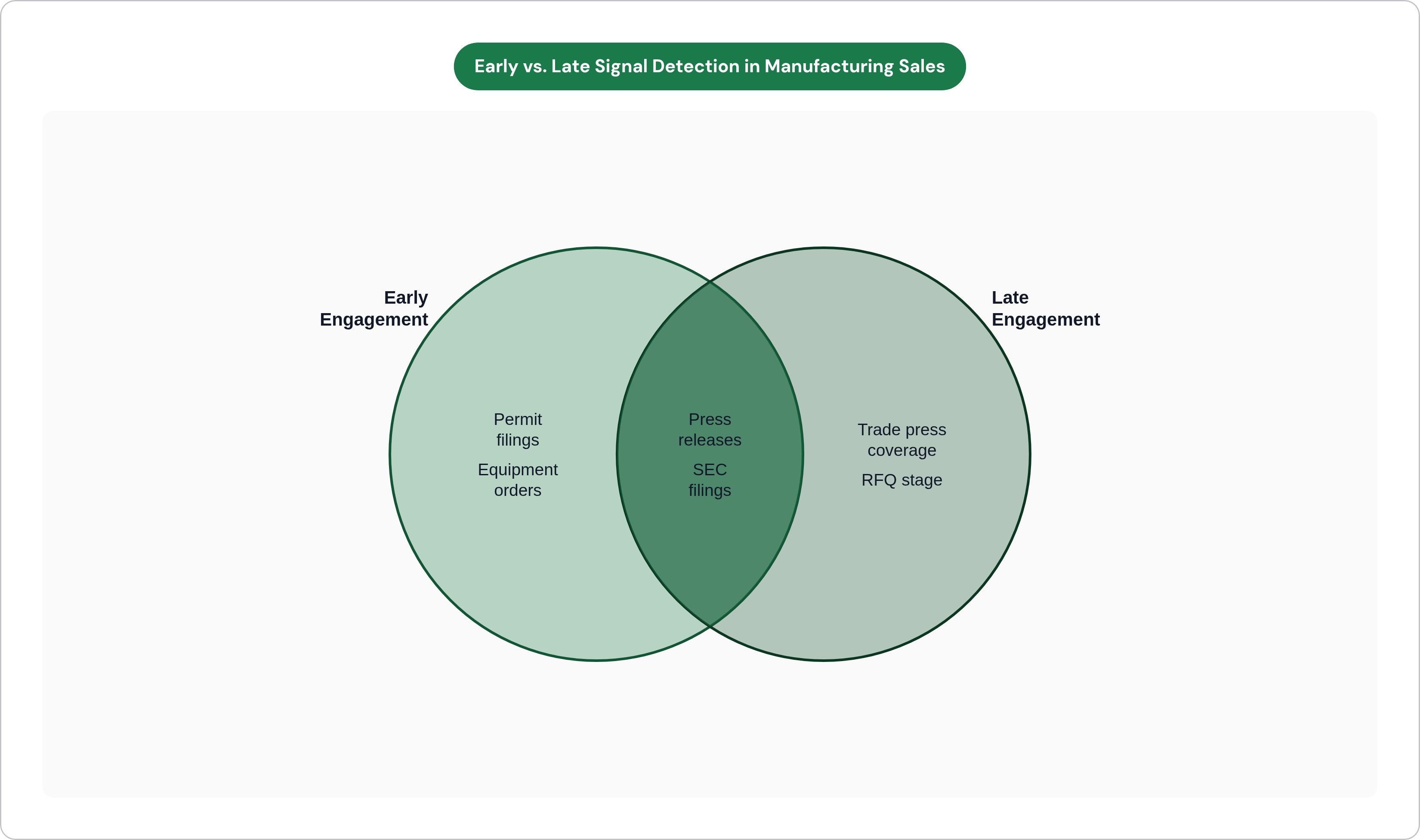
By the time an expansion shows up in a trade publication or a formal RFQ, the window for relationship-building has closed, and at that point you're competing on price, because price is the only lever left to pull.
How to build a repeatable process for catching expansion signals before the RFQ arrives
Start close to home. Map every facility you currently serve against what it produces and what it buys from you today, since the gap between those two lists is your first cross-sell target, and you don't need a single expansion signal to build it, just an honest audit.
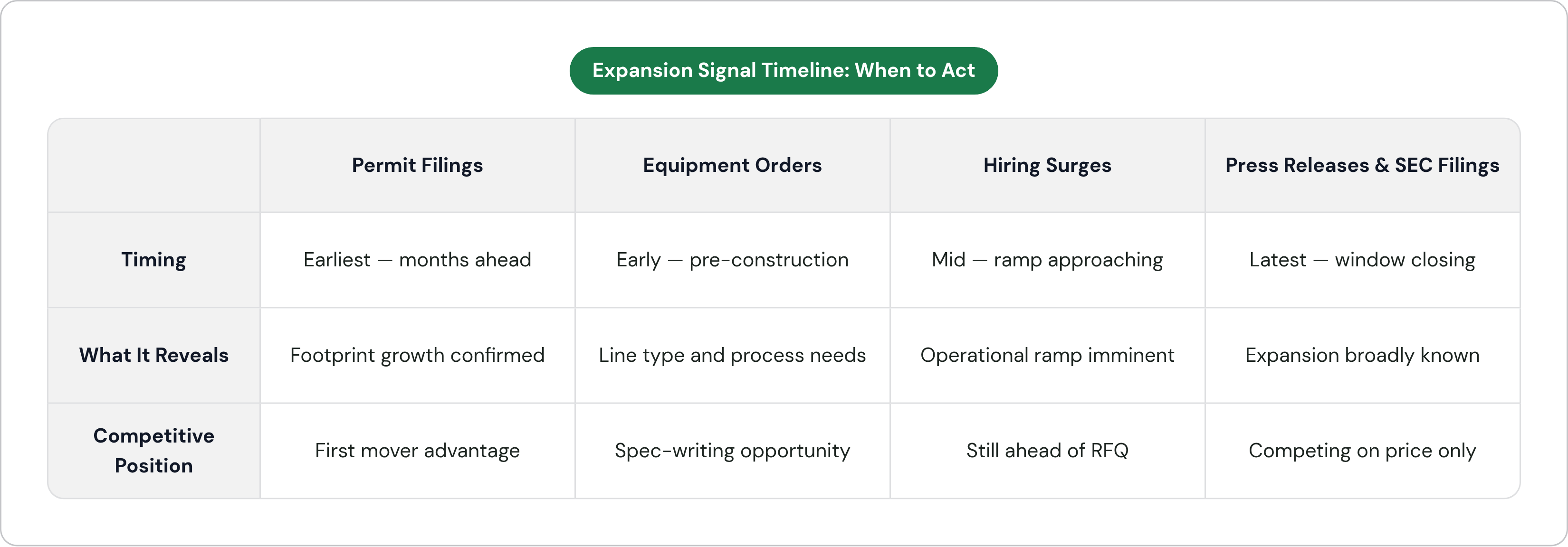
From there, layer in expansion tracking itself: capital project announcements, permit filings, equipment orders, construction activity, both at existing accounts and across target territories. These signals show up months ahead of the purchasing decision they eventually trigger. Permit filings and zoning approvals come earliest, often well before production starts. Equipment orders and supplier announcements come next, and they tell you the line type, which tells you the chemistry and consumable needs that follow from it. Hiring surges in operations, engineering, and maintenance roles signal the ramp is getting close. Press releases and SEC filings arrive last, and by the time you see those, competitors probably have too.
This changes how territories get built, or should. A mid-tier account going through a major expansion needs to jump the priority list, immediately, not next quarter. Territory models built on last year's revenue as a stand-in for future potential will consistently under-resource exactly the accounts with the most upside. Companies that build territory plans around real, current data instead of ad-hoc guesswork see about 15% higher revenue, a 20% bump in sales productivity, and planning time cut by roughly 75%. Feeding expansion signals into that process is one of the highest-leverage moves available to a sales org.
None of it matters if the information never reaches the rep where they actually work. Expansion signals sitting in a spreadsheet nobody opens do nothing on their own. They need to surface inside HubSpot, Salesforce, or Dynamics 365, attached to the account record, so the loop between intelligence and action actually closes instead of stalling out.
And the stakes rise with deal size. Large capital equipment purchases typically pull in multiple stakeholders across procurement, operations, engineering, finance, and safety. A rep who enters during the planning phase has time to build relationships across that whole committee, while a rep who enters at the RFQ stage is talking to procurement, and only procurement.
What plant-level data makes the difference between a signal and a qualified opportunity
An expansion announcement tells you something is happening, but it doesn't tell you what that something means for your product line, and that gap is exactly where good leads quietly die.
What actually converts a signal into something you can qualify: what the plant currently makes, in terms of production type rather than a NAICS code, what equipment it runs (which determines the chemistry and consumables it needs), current production volumes so you can size the opportunity instead of guessing, its environmental footprint and compliance profile (which often points to regulatory-driven purchasing you'd otherwise miss entirely), and what the expansion specifically adds, whether new process types, new lines, or new materials, and therefore which categories just opened up.
Without those specifics, a rep knows a plant is expanding but has no way to tell if it actually matters to them. That leads to wasted outreach at best, and at worst, a missed expansion inside an account they already own and thought they had covered.
This is the exact problem Corvus was built to solve. It indexes a large base of manufacturing plants and tracks detailed data points per facility, covering production type, equipment, output, environmental footprint, and real-time activity signals. That's the difference between knowing a plant exists and knowing what it actually needs from you specifically. The platform plugs directly into HubSpot, Salesforce, and Dynamics 365, so the signal and the plant-level context show up inside the CRM workflow instead of demanding a separate research step, the same 8 to 10 hours a week most reps already lose to manual digging.
The real test for any data source is simple, honestly: can it tell you a specific plant just added a stamping line, and can it tell you what that means for what you sell? Generic business databases can't answer that, but plant-level profiling built from production reality can.
Putting it into practice: moving from expansion signal to account conversation
Detect the signal early: a permit, an equipment order, a hiring pattern, an announcement, before any of it reaches trade press. Then qualify it using plant-level data to confirm what kind of expansion it is, and map that against your own product line. Does this open a brand-new category, expand existing consumption, or both?
Prioritization comes next, and not every signal deserves the same response. A large addition at an account you already serve beats a comparably sized greenfield project where you have no relationship at all, so weigh relationship depth and account size alongside the scale of the expansion itself. Then engage, and engage as a planning partner during the design phase, not as a vendor who shows up once procurement takes over. Getting there early is what buys you the chance to influence specifications before anyone writes them down on paper.
For existing accounts, this is just an extension of a relationship that already exists: we saw you're adding capacity, here's what that typically means for this product category, here's what's worked in similar expansions elsewhere. For new accounts, the expansion itself is the reason to call. It hands you something concrete and timely that generic prospecting never has, and it tells you the plant is in active buying mode for the next 12 to 24 months, not just browsing catalogs.
Do this consistently and it compounds. Reps who build this habit end up with a territory view where expansion activity is always visible, not something they stumble on after the fact over coffee with a plant manager. They walk into more conversations early, build relationships across more of the buying committee, and stop competing on price as often, because they're not the last vendor through the door asking what it would take.
The numbers behind all this aren't abstractions sitting in a slide deck somewhere. 1,702 new industrial projects were tracked in 2024, 154 new projects landed in November 2025 alone, and $1.955 trillion in announced investment is now tracked across 230 companies and 40 states. That's a live map of where purchasing decisions are being made right now, and the reps who learn to read it are working with an edge the ones still waiting for the RFQ simply don't have.